

How to Practice Economically, Effectively, and Result-Driven—Even When Life Is Crazy!
A new chorus season is just around the corner. The music is arriving. The calendar is filling up. Rehearsal schedules are appearing. Somewhere, a conductor is thinking, “I wonder how many people will actually learn their music before the first rehearsal?”
And somewhere else, a chorus member is thinking, “I have a job, a family, a house, appointments, friends, errands, three volunteer commitments, a vacation to plan, a dog who needs walking, and approximately 6,000 emails to answer. When exactly am I supposed to practice?”
Fair question. Most of us have busy lives. We don’t necessarily have an hour a day to sit at the piano with our score, a cup of tea, and the serene concentration of a monastic scholar.
But here’s the good news: You don’t need an hour. You need a plan.
The purpose of this article is not to convince you that you should practice more. It’s to suggest that you can practice smarter—and that a few minutes of purposeful work can make a surprisingly large difference when those minutes are used well.
The goal is simple: Let’s make the upcoming chorus season better than the last one. Not necessarily by singing more. By arriving at rehearsal more prepared.
Preparation Is a Gift You Give the Entire Chorus
When you’re prepared, you benefit. But so does everybody sitting around you.
When you know your notes, you can listen to the person next to you. When you know the rhythm, you can concentrate on ensemble. When you’ve worked out the words, you can watch the conductor instead of staring at the score as though it contains the secrets of the universe.
And when an entire chorus does this? Rehearsals change.The conductor doesn’t have to spend precious rehearsal time teaching individual singers notes and rhythms that could have been learned at home. The chorus can move more quickly into phrasing, dynamics, diction, balance, interpretation, and all the things that make music come alive.
In other words: Your preparation gives the conductor more time to make us sound fabulous. That’s a pretty good return on a few minutes of practice.
Busy Is Real. But It Doesn’t Have to Be an Excuse.
Let’s acknowledge something important: people really are busy. Some chorus members work full time. Some care for children or grandchildren. Some care for spouses or parents. Some travel. Some have second jobs. Some are involved in churches, boards, volunteer organizations, other musical groups, or approximately seventeen committees that somehow all thought you would be the perfect person to join.
And some of us are simply tired. So let’s stop imagining that effective practice requires a pristine practice room, a piano, an hour of uninterrupted time, and a perfectly organized life. It doesn’t.
Five focused minutes can be practice. Ten minutes can be practice. Fifteen minutes can accomplish quite a lot. Thirty minutes can make a serious dent. The trick is to give every session a job.
Don’t say, “I need to practice the music.”
Say: “I’m going to learn measures 112–120.”
Or: “I’m going to fix that rhythm.”
Or: “I’m going to learn the words to the last page.”
Now you’ve got a mission. And missions are much easier to accomplish than vague intentions.

A Secret Weapon: Start at the End
Here’s a little practice strategy that I have found particularly useful for chorus music: Work backward.
Most of us start at the beginning because, well, that’s where the music starts. Makes perfect sense. And because we start there, we generally know the beginning best. We’ve sung it more. We’ve heard it more. We recognize it immediately. Then we keep going.
By the time we reach the final pages, we’ve been concentrating for 20, 30, 40, or 60 minutes. Our brains are tired. Our voices may be tired. Our attention span has gone looking for a snack. And what happens to the music at the end? That’s often where our preparation falls apart. So try something different.
Start at the back and work forward. Learn the final page when you’re fresh. Then learn the section immediately before it. Then connect those two. Next time, move backward another section. Why? Because you’re giving the material that usually gets the least attention the benefit of your freshest brain and greatest energy.
Once you’ve learned it, you can rely increasingly on memory—muscle memory, brain memory, whatever you want to call it—instead of trying to learn brand-new material when your energy is depleted. It’s like putting gas in the car before the warning light comes on. And there is something wonderfully reassuring about getting to the end of a piece and thinking: “Oh, I know this part!”Rather than: “Oh dear. This is the part I was going to learn.”
The Five-Minute Practice
For the day when you have five minutes between everything else you’re doing.
Your mission: Pick one small problem. Work on it for five minutes.
Minute 1: Look at the passage. Identify the trouble spot.
Minutes 2–3: Isolate it.
- Wrong notes? Sing the notes slowly.
- Difficult rhythm? Speak or clap it.
- Words aren’t sticking? Speak them.
- Entrance after a long rest? Practice counting and entering.
- Foreign language? Work on pronunciation.
Minute 4: Put it back together.
Minute 5: Test yourself without stopping.
Success looks like: “That passage is better than it was five minutes ago.”
That’s it. Five minutes. No guilt. No grand piano required.
The Ten-Minute Practice
Your mission: Learn or reinforce a small section.
2 minutes: Notes
2 minutes: Rhythm
3 minutes: Words + music
2 minutes: Sing it at tempo
1 minute: Test yourself
If you’re working backward, use this time to tackle a section near the end.
Success looks like: “I can sing this passage with considerably less help from the score.”
The Fifteen-Minute Practice
Your mission: Take one passage from “I don’t know this” to “I can probably do this.”
3 minutes: Review something already learned.
4 minutes: Work on notes and rhythm.
4 minutes: Speak and sing the text.
3 minutes: Put everything together.
1 minute: Test yourself.
This is an especially good length of practice for those busy weekdays when you don’t have time for a full session. Fifteen minutes is short enough to fit into real life and long enough to accomplish something meaningful.
The Thirty-Minute Practice
Your mission: Make serious progress on a section.
5 minutes: Review—preferably starting near the end.
7 minutes: Notes and intervals.
6 minutes: Rhythm and entrances.
6 minutes: Text and pronunciation.
4 minutes: Put it all together.
2 minutes: Test yourself without stopping.
And here’s the important part: Don’t spend the entire 30 minutes singing what you already know. That’s the musical equivalent of cleaning an already-clean kitchen because you’re avoiding the garage. Go where the work is needed.
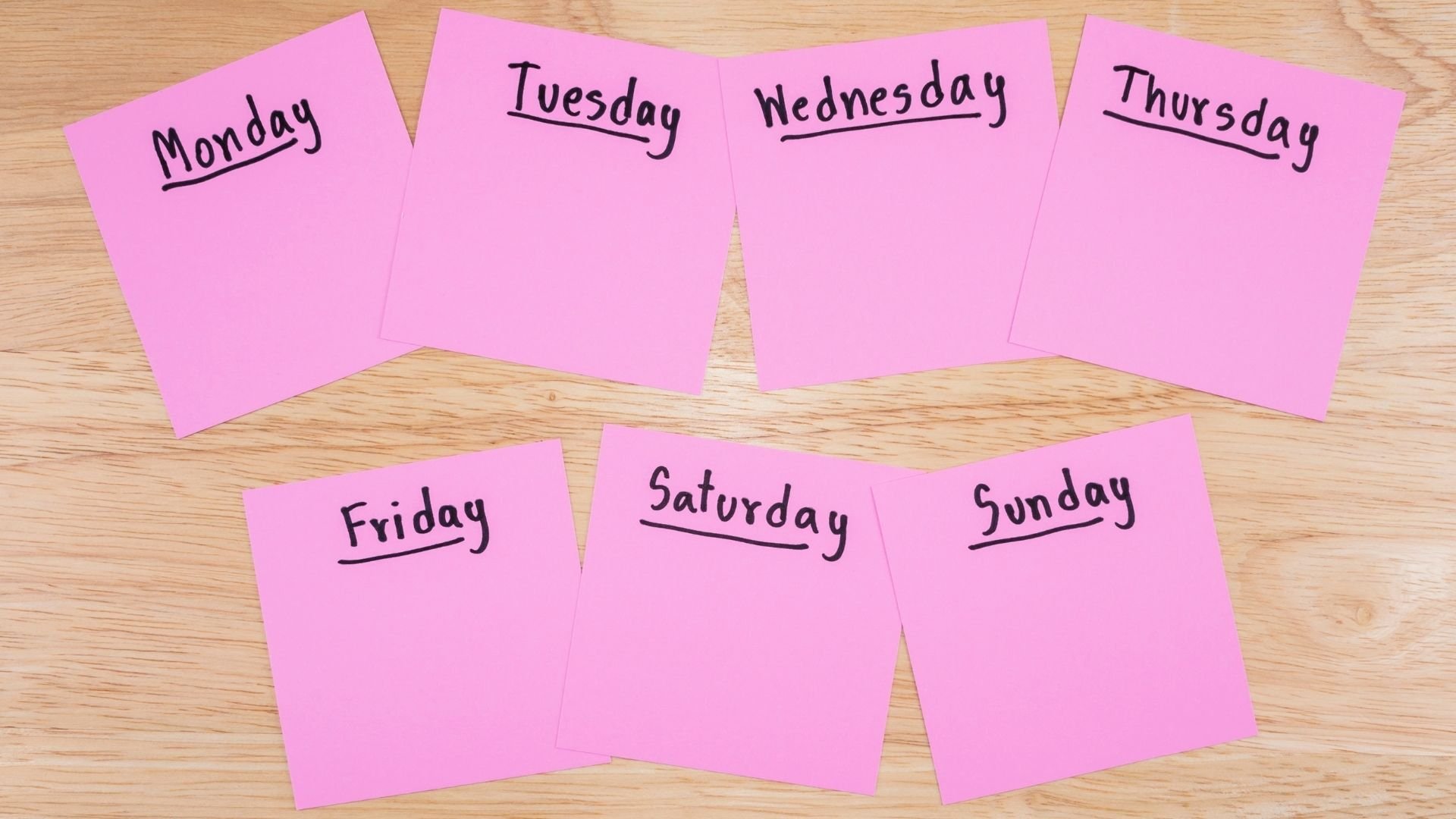
The Weekly Recipe
If daily practice isn’t realistic, here’s another approach.
- Monday | Start at the back. Learn the final section.
- Tuesday | Move backward. Learn the section before it and connect the two.
- Wednesday | Notes + rhythm. Attack the places that don’t behave.
- Thursday | Words. Speak them. Pronounce them. Memorize them.
- Friday | Trouble spots. Work on whatever caused you grief at rehearsal.
- Weekend | Connect the dots. Sing larger sections and eventually work toward a complete run-through.
Even 10–15 minutes four or five times a week can produce meaningful progress.
Don’t Practice What You Already Know
This may be the most important rule of all. We naturally gravitate toward the music we already know. It’s comfortable. It sounds good. It makes us feel accomplished. But if you can already sing measures 1–40, spending another 20 minutes singing measures 1–40 isn’t going to solve the problem in measures 125–150.
Go where the trouble is.
- If the notes are correct but the rhythm isn’t, practice the rhythm.
- If the rhythm is right but the words aren’t, speak the words.
- If everything is correct except the entrance after 16 measures of rest, practice that entrance.
- If the end of the piece is still a mystery, start there.
Economical practice means eliminating everything that isn’t necessary to solve the immediate problem.
And Yes, You Can Practice Without Singing
Your brain can do a remarkable amount of preparation without your vocal folds getting involved.
- Listen to your part while driving.
- Follow the score while listening to a rehearsal recording.
- Speak your text while walking.
- Practice difficult rhythms by tapping your finger on the steering wheel—preferably discreetly enough that the person in the next car doesn’t call the authorities.
- Read through the score before bed.
- Mentally rehearse your entrance.
- Listen to another section’s part and figure out how yours fits into it.
The Goal for This Season
Imagine what would happen if, at the first rehearsal of the new season, everyone had already spent a little time with the music. Not everyone would know everything. That’s not realistic. But instead of 100 people encountering the music for the first time, we’d have 100 people who had met it already.
Some would know the notes. Some would know the rhythms. Some would have learned the words. Some would have worked on the difficult entrances. And all of us would be starting from somewhere farther ahead than zero. That’s the point.
Preparation doesn’t have to be perfect to be powerful. It just has to happen.
So let’s make a deal for the coming season: Don’t promise to practice for an hour every day. Don’t create a heroic practice schedule that lasts four days and then collapses under the weight of real life.
Instead, promise to practice purposefully. Five minutes when that’s all you have. Ten when you can. Fifteen when the day cooperates. Thirty when you have the time. And every once in a while, start at the back. Because the goal isn’t to accumulate practice minutes. The goal is to arrive at rehearsal better prepared than you were at the last one.
And if we all do that? We won’t just have a better-prepared chorus. We’ll have better rehearsals. We’ll learn music faster. We’ll have more time for musical interpretation. We’ll listen to each other more. We’ll become a stronger ensemble. And, perhaps best of all, we’ll spend less rehearsal time collectively staring at the conductor with the expression that says: “Wait…what page are we on?”
That’s my recipe for a successful upcoming chorus season:
A little preparation. A little consistency. A little strategic thinking. And a lot less guilt.
Let’s make this season better than normal. Let’s make it extraordinary!
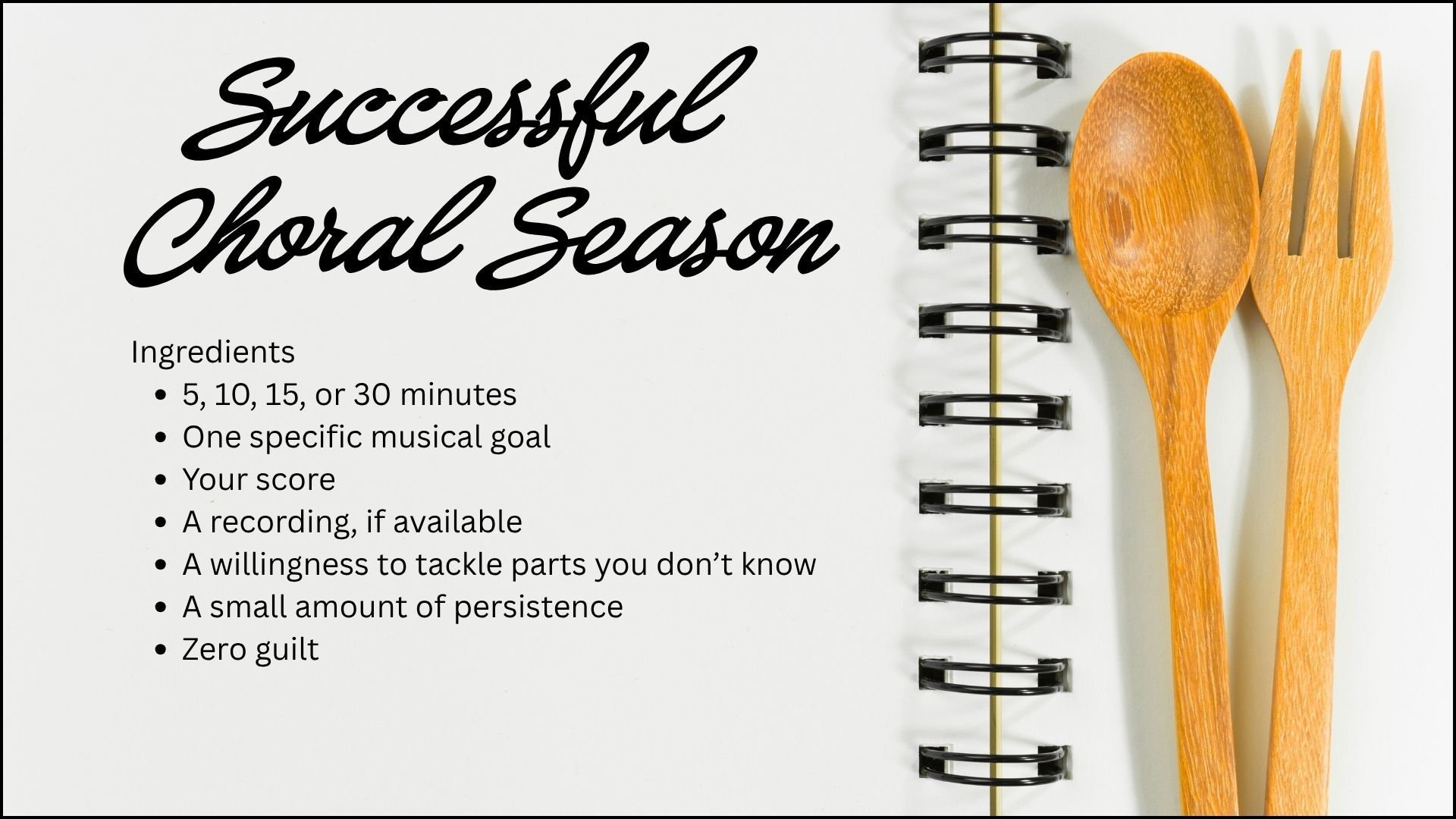
🍳 THE RECIPE CARD
Recipe for a Successful Chorus Season
Yield: One better-prepared chorus
Prep time: 5–30 minutes at a time
Difficulty: Surprisingly easy
Special equipment: Score, pencil, recording—and a brain
INGREDIENTS
- 5, 10, 15, or 30 minutes
- One specific musical goal
- Your score
- A recording, if available
- A willingness to tackle the parts you don’t know
- A small amount of persistence
- Zero guilt
DIRECTIONS
- Pick a target. Don’t practice “the music.” Practice measures 47–55.
- Start at the back. Give the end of the piece your freshest brain.
- Separate the ingredients. Work independently on:
- 🎵 Notes
- 👏 Rhythm
- 🗣 Words
- 🎼 Entrances & cutoffs
- 🎶 Dynamics & articulation
- 👂 Listening & ensemble
- Put them together. Sing the passage as it will actually be performed.
- Test yourself. Close the score. Sing it without stopping. See what stayed.
- Move backward. Next practice session, tackle the section before the one you’ve learned.
- Don’t waste ingredients. Don’t spend 20 minutes practicing something you already know.
CHOOSE YOUR SERVING SIZE
5 minutes: One problem
10 minutes: One small passage
15 minutes: One meaningful section
30 minutes: Several connected skills or a difficult passage
THE SECRET INGREDIENT
Consistency beats heroics. Five minutes today + ten minutes tomorrow + fifteen minutes later in the week is far more useful than waiting for the mythical afternoon when you will have two uninterrupted hours, unlimited energy, and absolutely nothing else to do.
SERVE AT THE NEXT REHEARSAL
Arrive prepared enough that rehearsal can be about: music—not survival.
FINAL RESULT
A chorus that learns faster, listens better, rehearses more efficiently, and has more time to make beautiful music together.
Bon appétit—and happy singing!
Share your tips for rehearsal… What do you do to prepare for the first rehearsal? What recipe for weekly rehearsal will you commit to this season? Tell us in the comments below!


Lola Watson, Soprano, has sung with success on both national and international stages. She made her Carnegie Hall Debut, in New York City, singing Mozart’s Coronation Mass. Her Violetta, in Verdi’s La Traviata in San Francisco, Juliette, in Gounod’s Romeo et Juliette with the New Jersey State Repertory Opera, and the title role in Moore’s The Ballad of Baby Doe, are a few of Ms. Watson’s most successful roles. The role of Rossane in Handel's Alessandro, Ms. Watson’s European Debut, with Maestro Nowaskowski and the Sinfonia Varsovia in Warsaw, Poland, can be heard on a live recording released by the Schwann-Koch label. Ms. Watson has been heard with the Minnesota Orchestra singing the High Priestess In Aida and as the Mother in a fully staged production of Humperdinck’s Hansel and Gretel which she also performed with the Denver Symphony. She also sang with the Atlanta Symphony Chorus under Robert Shaw and for twenty years was a contracted singer with the Minnesota Chorale under Dr Kathy Romey Salzman, She is currently a staff singer with the San Diego Master Chorale and the San Diego Symphony Chorus, and a member of the La Jolla Symphony Chorus. In addition to a successful music career, Lola also celebrates a 45 year career as a nationally published, award winning interior designer, and former President of the American Association of Interior Design, Minnesota Chapter representing over 500 members. She happily lends her talents to causes that are dear to her heart; Children’s Cancer Research Fund / Dare to Dream Benefit, DIFFA /DIVA Ball and The Alzheimer’s Gala, to name just a few.